
Why Publishing My Book, "Brand Strategy in Three Steps,"Changed Nothing and Changed Everything
I wasn’t ready. The market wasn’t ready. Now both are starting to be.
Jay Mandel
2/22/20265 min read
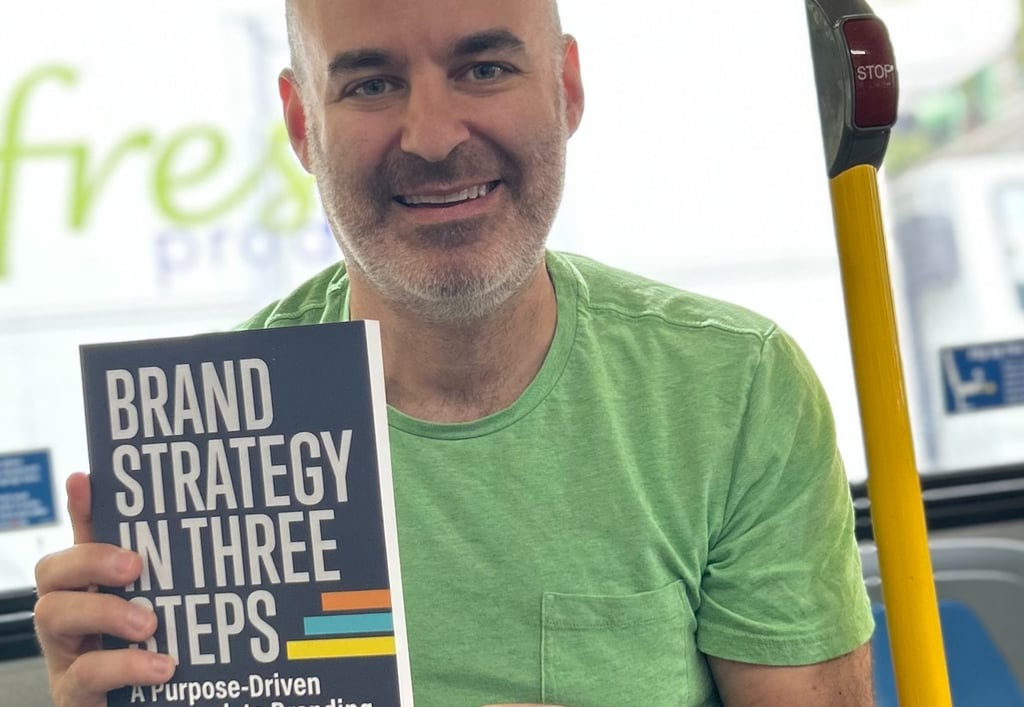
Two years ago, the Marketing Accountability Council was created to address the uncomfortable gap between what marketing claimed to be (creative, strategic, value-creating) and what it was increasingly becoming (extractive, manipulative, and optimized for optics over outcomes). MAC began as a place to publicly process that dissonance. What I didn’t fully understand at the time was how much of that dissonance was rooted in my own life. Over the last decade, I’ve watched systems fail much closer to home.
In 2023, a year before I formed the MAC, I published Brand Strategy in Three Steps with the business book publisher, Kogan Page. The book outlines a framework for creating an authentic brand by focusing on core values, connecting them to products and services, and implementing the strategy through meaningful customer interactions. The three steps are clear: Brand Identity (identifying core values), Setting Intentions (linking values to offerings), and Implementing the Strategy (rolling out the plan). It offers practical exercises to craft a “living brand document” for both new and established companies. On its own terms, it works.
But if I’m honest, the experience of writing and publishing the book was more complicated than the framework itself. I hadn’t fully found my voice yet. And the publishing process didn’t necessarily help me find it; it shaped it. The tone leaned more academic, more restrained, more conventional than what now feels natural to me. What emerged was competent, structured, and respectable. The format ( an academic-style business book ) also felt slightly misaligned with what I was trying to express. I still believe in the principles, and I believe that if companies applied them sincerely, they would be better off. But I also recognize that the container matters as much as the content.
Around the same time, I discovered a 2019 YouTube video from the American Anthropological Association featuring its spokesperson, Tricia Wang. The video listed “sell more books” as a reasonable business objective. But when reframed by asking instead how people were learning, why they chose books, and where they were actually turning for information, the conversation changed. Books weren’t just competing with other books; they were competing with podcasts, video, social feeds, and the increasingly fragmented way people consume knowledge. The issue wasn’t simply marketing; It was context.
Looking back, I can see that I didn’t fully apply that same lens to my own work. I was operating within a traditional model of credibility; the idea that depth requires length, that seriousness requires a certain tone, that legitimacy is tied to format. Those assumptions weren’t wrong, but they belonged to a particular moment and system. If I had asked myself the human question more directly; How will people actually engage with these ideas now? I would have made different creative choices. The ideas I care about aren’t static or linear. They evolve through conversations, through essays, through reacting to what’s happening in real time. Trying to compress that into a traditional business book felt like pouring something alive into a mold that had already hardened.
What made it harder was watching the publisher treat the book as a catalog item rather than a living work. The price stayed high, and the marketing was minimal. And despite my background in marketing, there was little interest in experimenting, iterating, or doing the kinds of things that actually build an audience. It felt boxed in from start to finish.
That experience taught me something important, not just about publishing, but about voice. I realized that the way I actually think, write, and communicate doesn’t belong in tightly controlled formats designed to smooth out personality. My work is sharper, messier, more personal, and more honest than that.
I made very little money from the book. And if I’m being honest, no significant wave of new opportunities followed it. For a long time, I questioned that. I wondered if it meant the work hadn’t landed, or if I had missed something. But over time, I came to a different conclusion; it wasn’t just about me. It was about the time we were living in. I wrote that book in the middle of the pandemic, during a period of contraction: economic, emotional, and institutional. Companies weren’t looking for big ideas; they were looking for cost cuts. Leaders weren’t rewarded for long-term thinking; they were rewarded for survival. Risk tolerance dropped across entire industries. Budgets tightened, hiring slowed, and experimentation shrank.
In that kind of environment, thoughtful work often doesn’t get traction, not because it lacks value, but because the system around it isn’t ready to absorb it. And we are still living in that contraction. The surface of the economy may look stable, but underneath, companies remain cautious. Decision-making is centralized, procurement is slower, and innovation is talked about more than it is funded. There is a constant pull toward short-term certainty, even when everyone knows that certainty is an illusion. That environment does not reward big ideas unless it’s AI or an out-of-touch tech company.
What I’ve come to understand is that much of the work I’ve been doing over the last several years, writing, teaching, building MAC, and developing the ideas behind Clean Data Alliance , has been early work. Foundational work. The kind of work that often happens before a market is ready to recognize it. That doesn’t make it a wasted effort; it makes it preparation.
Because markets move in cycles, and periods of contraction are followed by periods of rethinking. Eventually, organizations realize that cost-cutting alone doesn’t create growth. Eventually, leaders begin looking again for frameworks, language, and models that help them rebuild smarter. And that is where the Clean Data Alliance connects the dots.
What began as writing about trust, incentives, and accountability through the Marketing Accountability Council has evolved into a framework, a set of tools, and a way of working that addresses one of the most pressing issues of the next decade: how organizations collect, interpret, and use data in a way that respects people and produces better decisions. For years, that message may have felt ahead of the market, and now the market is beginning to catch up. Trust is declining dirty data is becoming a recognized liability. AI systems are exposing how flawed many datasets really are. Regulators are paying attention. Consumers are becoming more aware of how their information is used. Companies are starting to realize that the quality of their data (and the trust behind it) will define their competitiveness. The ground is shifting. And what once felt early is starting to feel timely.
Looking back, I no longer see the book or the years that followed as a period of stagnation. I see them as a period of laying foundations, when very few people were thinking about what would come next. The market doesn’t reward the future until it arrives. But when it does, the people who spent the quiet years building tend to be the ones who are ready. And I believe that moment is closer than it appears.